
 Written By:
 Edited By:
Picture a traveler comparing two safari trips. One calls itself “eco-friendly.” The other promises a solar-powered camp with no generator humming at night and a local guide who can follow a leopard by its tracks. Which one do you believe? Which one do you remember?
“Eco-friendly” is a common phrase in travel marketing, but under new green claims laws like the EU’s EmpCo Directive, that kind of vague claim is a legal risk, not just a weak pitch. The good news is that one change can make your marketing more credible and more engaging. Here is how to do it.
Sustainability buzzwords don’t sell
Even without green claims laws, sustainability buzzwords like “eco-friendly,” “green,” and “responsible” would still be a marketing problem. They make it harder for travelers to trust you and care about what you do.
They’re hard to trust
These words don’t tell travelers what a business did, where, or how much it helped. Without those details, travelers are left wondering whether there’s action behind the claim or just a nice coat of green paint.
They have good reason to wonder. The European Commission found that more than half of the environmental claims it examined were vague, misleading, or unfounded. It’s no surprise that many travelers no longer take these claims at face value. And while most travelers care about sustainability, one in four do not trust that trips labeled “sustainable” really are. So a vague claim doesn’t just fail to help you; it can actually raise doubt and make travelers trust you less.
Part of the problem is that travel providers use “eco” in very different ways. A beachfront hotel might call itself an eco-resort even if it cleared mangroves to build it and its wastewater flows untreated into the sea. Down the coast, another hotel might use the same word because it protects mangroves along the shore and recycles its wastewater to water the gardens. The first is greenwashing. The second is ecotourism. But on a booking site, the two look the same: palm trees, ocean views, and a little green leaf next to the name. Most travelers have no way of knowing what happened to the coastline or where the wastewater goes. And once they’ve heard enough stories about greenwashing, many stop trusting the word altogether, which hurts the hotels actually living up to their claims.
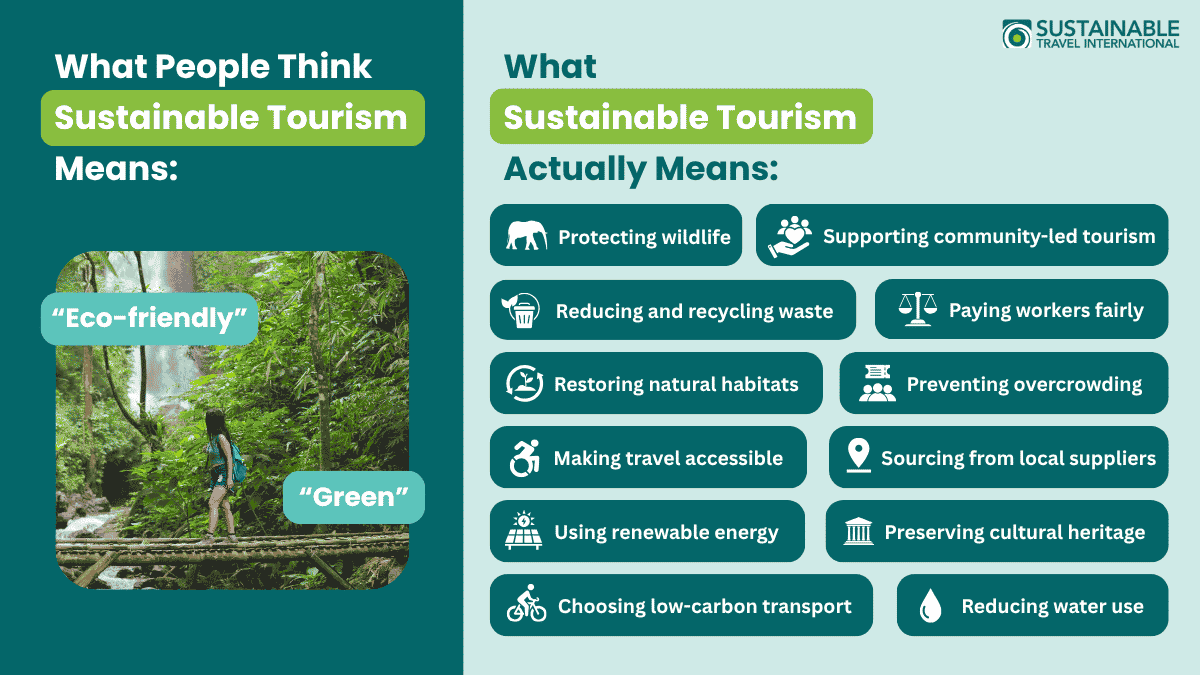
Terms like “eco-friendly” and “sustainable” are also so broad they could mean almost anything: lower emissions, waste reduction, water conservation, wildlife protection, fair wages, cultural integrity, and more. Using them suggests a business excels at all of it, which is nearly impossible in practice. So when a business is really talking about one or two efforts, travelers may start poking holes in everything else. Naming those one or two things clearly is far more convincing.
They’re easy to forget
Terms like “eco-friendly” have been repeated so often that they’ve lost their meaning and travelers tune them out. And because competitors use the same words in their marketing, they no longer set a business apart.
Most of all, these words skip the stories. Those stories get travelers excited about a trip and show them what sustainability adds to the experience. “Eco-friendly” can’t compete with the farmer down the road whose morning harvest puts the region’s flavors on tonight’s menu. Or the orangutan conservation project an operator supports to protect habitat for the very apes guests travel to see. Details like these turn sustainability from a label into a reason to book.
What changed: EmpCo turned a weak story into a legal risk
The EmpCo Directive is an EU law designed to curb greenwashing by setting rules for how businesses talk about their environmental and social impact. It has been in effect since September 2026, and it applies to any business that markets to travelers in the EU, regardless of where that business is based.
Businesses were already facing legal and regulatory challenges over their sustainability claims before EmpCo. In 2024, a Dutch court found that KLM’s ad claims were misleading for using vague environmental statements to suggest flying could be sustainable. A year earlier, the UK’s advertising regulator ruled against Intrepid Travel’s “people & planet-friendly” tagline because travelers were likely to read it as covering more than the company intended. Booking.com also pulled its “Travel Sustainable” badges after a Dutch regulator found the label didn’t make clear what it referred to.
What EmpCo adds is clarity. Earlier cases hinged on whether a particular ad was judged misleading. EmpCo bans broad claims like “eco-friendly” or “sustainable” outright unless a recognized certification covers that exact claim. Otherwise, you need to say specifically what you’re doing and be able to prove it. You also can’t present one green feature, like giving guests reusable water bottles, as if it makes the whole trip sustainable. For a full breakdown of what the directive requires, see our guide to the EU’s new green claims rules for tourism businesses.
In other words, the terms that were already weak marketing now carry even greater legal risk. Not sure whether your copy could get you in trouble? Run it through our Green Claims Checker to see. Then use the steps below to rewrite anything it flags.
Stop making vague claims. Start showing what you do.
The fix for vague claims is the same whether your goal is better marketing or staying compliant: stop thinking of them as claims at all. Instead, imagine explaining what you actually do to a traveler who has never heard the word “sustainability.” Your marketing should sound like that answer, highlighting specific actions you took and why they matter.

Strong messaging starts with the facts: what you did, where you did it, and how much it helped. But it also leans into why you did it and what it means for the traveler. People, places, and wildlife make a story real: the woman who welcomes your group into her family home for a home-cooked lunch or the sea turtles your local partner protects on a nearby nesting beach.
For example, instead of saying “We operate climate-friendly tours”, say “On our Italy tours, we’ve replaced 70% of the domestic flights on our tours with train travel, cutting the emissions from getting between cities roughly in half.” Travelers can picture it, check it, and trust it. And it’s far less likely to run into trouble under rules like EmpCo.
Then bring it to life by showing what the change means for the trip. Travelers watch the countryside roll past the window instead of waiting at a gate, and they arrive in the heart of the city instead of at an airport. That’s what makes it memorable, not just credible.
Measurement proves your story is true
Numbers are one of the most convincing details you can add to your sustainability communications. They turn a general promise into concrete evidence. But a line like “we cut our emissions in half” only works if you actually know the amount. That’s where measurement comes in.
For example, measuring a trip’s emissions before and after you make changes, like swapping flights for trains, tells you exactly how much you reduced the footprint. That’s why it’s important to start measuring what you can now: you need a starting point to track progress.
Humí, our AI-powered carbon footprinting tool, is built exactly for this. Upload a PDF itinerary or paste a link to a tour page, and in seconds you’ll see a breakdown of the tour’s emissions across accommodation, transportation, activities, and meals, down to individual components like a flight or catamaran ride. You can share those results with travelers by adding a carbon label to the tour page, so they can see its footprint for themselves. After you’ve updated the itinerary to lower emissions, upload the new version to measure the difference.
Check your wording before you publish
Once you’ve drafted your sustainability messaging, test it before it goes live. Paste your marketing language into our Green Claims Checker, and it will flag phrases that could mislead travelers and explain why. Sustainable Travel International members have access to an expanded version of the tool that screens against specific regulations, such as EmpCo or California law, gives more in-depth results, and suggests rewrites. It’s a quick way to catch a risky phrase before a traveler, partner, or regulator does.
Start telling a better sustainability story
Terms like “eco-friendly” ask travelers to trust you. Specific details give them a reason to trust you, while also showing what sets your trip apart. That’s better marketing and safer marketing at the same time.
Start by running your current marketing through our Green Claims Checker, then set your baseline footprint with Humí.
For more support, explore Sustainable Travel membership. Members get the expanded Checker, Humí reports, and opportunities to share their story with our sustainability-minded audience.