
 Written By:
  Edited By:
 For many years, tourism businesses have used words like “green,” “eco-friendly,” and “responsible” to position their products as sustainable. But even when businesses have good intentions, broad green claims without proof make it difficult for travelers to distinguish real action from greenwashing.
That is starting to change. From September 27, 2026, a new EU directive introduces stricter rules for sustainability marketing. The Empowering Consumers for the Green Transition (EmpCo) Directive sets stricter rules for how businesses talk about their environmental impact.
For tourism businesses, this is about more than regulatory compliance. It reflects a wider shift toward demonstrating environmental impact rather than simply claiming it. The good news is that if you are already doing the work, following the EmpCo Directive is manageable. This guide walks you through what the EmpCo Directive is, who it affects, what it asks of you, and the steps you can take today to prepare.
What is the EmpCo Directive?
The EmpCo Directive is an amendment to existing EU consumer protection laws. It introduces new rules designed to protect consumers from misleading environmental claims and improve the information they rely on when making purchasing decisions. It addresses practices such as:
- Broad claims like “green,” “eco-friendly,” or “responsible”
- Claims that cannot be backed up with evidence
- Claims that overstate environmental benefits
- Sustainability labels and badges that are not tied to a certification scheme
- Claims about climate impact based only on carbon offsets
- Promises about the future that have no real plan behind them
Why Was It Introduced?
Over the past decade, consumer demand for more sustainable products and services has risen. In response, businesses have increasingly promoted the environmental benefits of their products.
However, the rapid growth in sustainability marketing has also increased confusion about which claims can be trusted and what different terms actually mean. A 2020 European Commission study found that 53% of environmental claims were vague, misleading, or unfounded. Today, over half of consumers do not trust sustainability claims made by brands.
To help restore consumer trust, the European Union adopted the EmpCo Directive. It marks one of the most significant updates to environmental marketing rules in recent years and has important implications for tourism businesses.
You may also have heard about the proposed Green Claims Directive. While related, it is separate from the EmpCo Directive. EmpCo has been adopted and establishes rules for business-to-consumer sustainability marketing. The Green Claims Directive would introduce more stringent requirements for substantiating claims, but it has not been adopted.

Who Do the Rules Apply To?
Here is a simple rule of thumb. If you sell travel to travelers in the EU, or provide products or services to companies who do, these standards should inform everything you say.
The Directive covers green claims made to consumers in the EU. For the tourism industry, that includes tour operators, hotels, travel advisors, destination marketing organizations, and any other company that markets its environmental efforts to travelers. Even if your communications are primarily shared with other travel businesses rather than directly with travelers, these requirements are still relevant, since your messaging may be reused in your partner’s consumer-facing marketing.
Where your company is based does not matter. If you market to consumers in the EU, these rules still apply regardless of whether you are located in the United States, Africa, Asia, or Latin America.
What Does It Require?
Under the Directive, green claims must be clear, accurate, and supported by evidence.
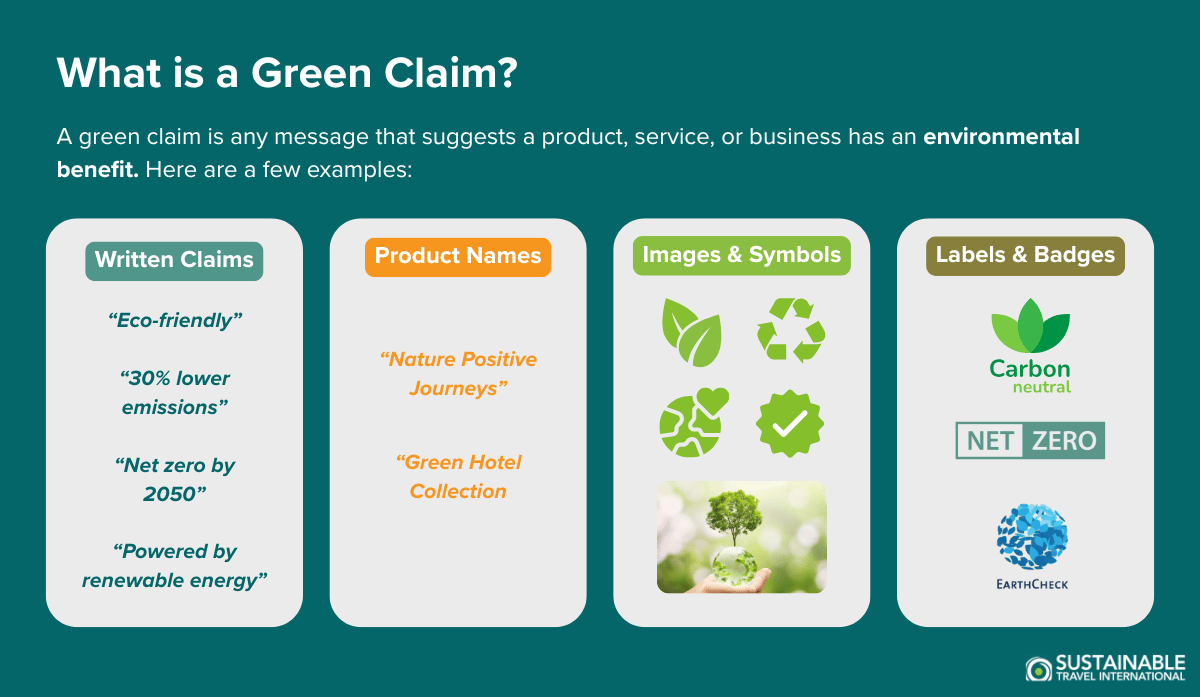
The term “environmental claim” is defined broadly and is not limited to written statements. Company names, product names, logos, symbols, and images can all count if they suggest an environmental benefit. For example, a tour collection named “Nature Positive Journeys,” a claim that a hotel is “carbon neutral,” or a badge featuring a leaf icon and the words “travel consciously,” could each be read as a claim.
Not every green claim is prohibited. Instead, the Directive sets rules for how they can be made. The law is detailed, but it comes down to a few clear ideas.
Replace vague claims with specifics about what you’re doing
When every hotel is “eco-friendly” and every tour is “green,” those words start to lose their meaning. Under the Directive, generic environmental claims that are not specific enough to be understood or verified are prohibited because they can mislead consumers about a product’s environmental performance.
Instead, describe the specific action or improvement behind the claim. “We replaced 90% of domestic flights on our tours with train travel, reducing transportation-related emissions by about one-third” works well, because it explains exactly what was done and the benefit. “Climate-friendly tours” tells a traveler nothing about your efforts.
You can also use stories to show your impact through concrete examples rather than simply claiming it. Instead of saying “our lodge is sustainable,” introduce the local farmers who supply fresh ingredients for your restaurant or explain how a habitat restoration project is helping native species return.
Specific actions are even more compelling when paired with measurable results. Whenever possible, include data that shows the scale of your impact, such as emissions reduced, waste avoided, water saved, or the percentage of local suppliers you work with.
There is one limited exception to the Directive’s prohibition of generic claims. Broad claims like “eco-friendly” can be used when they are supported by a recognized certification that directly covers the specific claim. This includes the EU Ecolabel for Tourist Accommodation and EN ISO 14024 Type I ecolabels, such as the Nordic Swan Ecolabel for Hotels and Accommodations and Austrian Ecolabel.
Do not overstate how far a claim reaches
A common reason travelers get frustrated with greenwashing is that it can overstate what a business actually does, even when that’s not the intention. The fix is simple: clearly communicate the scope of your green claims.
If only your office runs on renewable electricity, say exactly that. Do not market the whole company as “powered by renewable energy.” The same goes for your trips. If only a few have been redesigned to lower emissions, do not label your entire catalog “low carbon.”
Note that you should also avoid advertising environmental benefits that are legally required for all products in your category. For instance, do not frame mandatory practices such as eliminating plastic bottles as unique benefits if they are already banned across the destination. You can still mention these practices, but simply present them as adhering to local regulations rather than a distinctive sustainability achievement.
Lead with reductions, and treat external climate funding as something separate
The Directive draws a clear distinction between reducing a business’s own environmental footprint and funding climate action outside its value chain. This is particularly relevant for businesses that purchase carbon offsets or invest in other climate projects. Both are important, but they play different roles. These contributions are a positive way to support global climate action, but they do not reduce or eliminate the carbon footprint of a specific trip, hotel stay, or travel product. Marketing should therefore avoid any language suggesting that external climate funding changes or neutralizes the environmental impact of the product itself.
This means you can no longer describe a tour, hotel stay, or flight as “carbon neutral” or “climate compensated” based on carbon offsets. You should also avoid language suggesting that you’re mitigating your environmental footprint through carbon offsets.
Rather than describing carbon offsets as a way to compensate for emissions, communicate them for what they actually are: an investment in global climate action that goes beyond the emissions reductions you can achieve within your own operations. Explain how these investments fund initiatives, such as forest protection or renewable energy, that help address climate change at a scale no single business can achieve alone. For example, instead of saying “we are compensating for our footprint through offsets”, say “we invest in projects that protect forests and other ecosystems that absorb carbon, which deliver emissions reductions equivalent to the footprint of our trips.”
Reducing your own emissions remains the priority, but it takes time, and climate change won’t wait. Investing in climate solutions allows your business to do more, sooner, while you continue reducing your own emissions. It’s a different approach than reducing, but it works toward the same ultimate goal. They are not a substitute for reducing emissions, but an additional way to help address the same global challenge.
Back up your claims with evidence
By now, you’re probably noticing a common theme. It’s no longer enough to simply make a sustainability claim. You should also be prepared to substantiate it. How you do that will depend on the type of claim you’re making.
If you claim you’ve improved your sustainability performance, you should have evidence to back it up. That starts with measuring where you are today, so you can track your progress over time. For example, if you say you’ve reduced the carbon footprint of your tours, you should be able to demonstrate that reduction. The same principle applies to claims about waste, water, biodiversity, or other sustainability improvements. A simple way to get started is by measuring the carbon footprint of your tours with Humí or your accommodation with our Hotel Carbon Measurement Tool.
This principle doesn’t just apply to claims about what you’ve already achieved. It also applies when you publicly communicate your sustainability goals and commitments for the future. Ambitious sustainability goals are common, and that’s a positive step. However, the Directive is designed to ensure these commitments are more than aspirational statements. Any forward-looking sustainability claim, such as a commitment to “achieve net zero by 2050” or “go plastic free,” should be backed up by a detailed and credible implementation plan. This should include measurable, time-bound targets, specific actions, and dedicated resources. The plan must also be publicly available, with progress regularly reviewed by an independent expert.
Only use legitimate sustainability labels
Sustainability labels and certifications can quickly signal trust and credibility to consumers. Because they carry such weight, the Directive sets rules for which labels businesses can display and who is allowed to issue them.
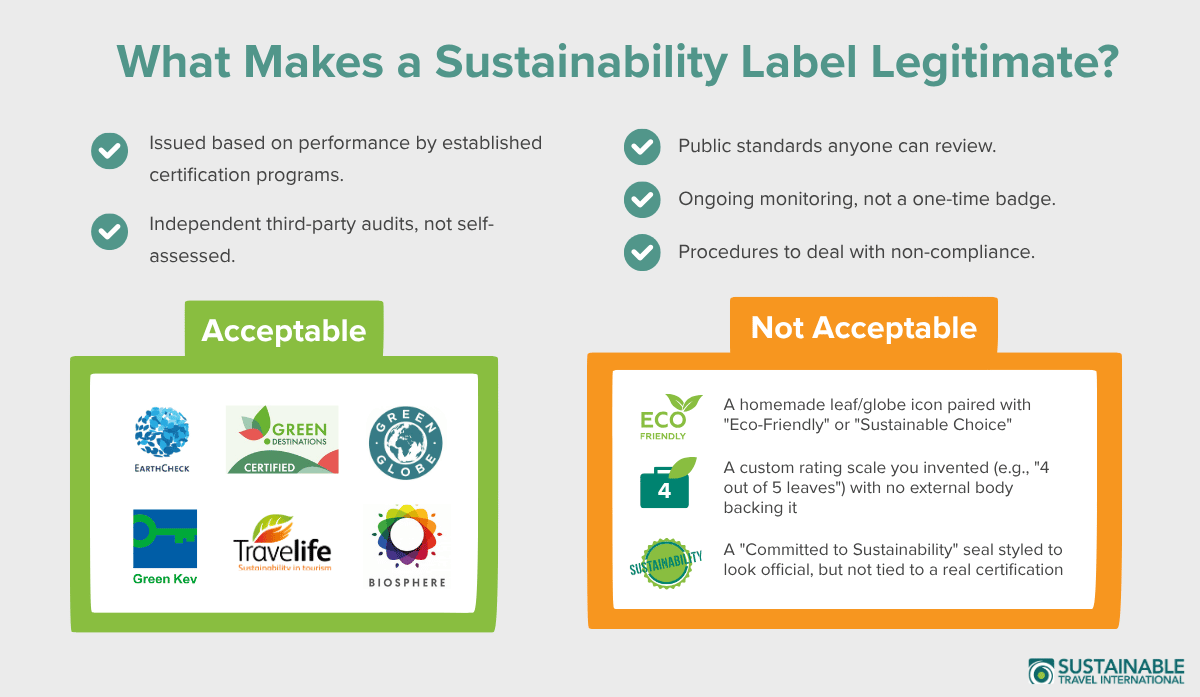
If you display a badge, logo, trust mark, or seal suggesting your business or destination meets certain environmental or social standards, it must come from a legitimate source. This could be a public authority or a certification program with published standards and independent, ongoing monitoring. Travelife, Green Key, Green Globe, EarthCheck, and Green Destinations are all well-established examples in tourism that meet this bar.
What you can’t do is create your own label. Even something as simple as a homemade “Committed to Sustainability” badge on your website or “Carbon Neutral” stamp on your tour webpages is not allowed. If it’s not backed by a legitimate third-party certification body, it shouldn’t be presented as a label at all.
Be open about comparisons
Environmental rankings and comparisons can help consumers make more informed choices, but only if they are objective and transparent. It is fine to provide these, but the Directive requires them to be transparent and based on consistent methods. For example, a booking platform cannot display “lower carbon footprint” rankings without explaining how the footprints were calculated and ensuring the same emission sources and assumptions were used for every product.

Simple Steps to Get Ready
If you start early, most of this is easy to manage. Here is a checklist to work through.
- Review the sustainability claims you make. Start by running your website copy or other marketing materials through our free Green Claims Checker to identify potentially misleading claims and receive suggestions for improvement. For more guidance, download our free Green Claims Messaging Guide for examples of environmental claims to avoid and better ways to communicate your sustainability efforts.
- Replace vague terms with specific evidence. Remove broad terms like “eco-friendly” or “green” that are not backed by a recognized certification. Wherever possible, replace them with measurable actions, data, or specific examples.
- Be ready to substantiate your claims. Be prepared to explain the data and methodology behind your claims where appropriate, and publish an implementation plan for any forward-looking environmental commitments. If you’re developing a climate action plan, our team can review it to help ensure it is credible.
- Reframe how you talk about carbon offsets. Update any messaging about carbon offsets to present them as an investment in climate action beyond your operations, rather than as something that changes your footprint or creates carbon neutrality.
- Start measuring. Build a baseline and gather data now, so your future claims are specific and easy to defend. We offer tools to measure the carbon footprint of tour itineraries, hotels, and events, including Humí, our AI-powered tool that measures itinerary emissions in seconds.
- Educate your team. Make sure everyone involved in creating customer-facing communications understands the Directive and your organization’s approach to sustainability claims. Our member-exclusive Sustainable Tourism Marketing Guide, coming soon, will provide practical guidance on communicating sustainability in ways that engage consumers while avoiding common greenwashing pitfalls.
Want a simpler way to bring this all together? Sustainable Travel Membership gives tourism businesses access to a growing collection of practical tools, resources, and expert support to help strengthen sustainability efforts and communicate them with confidence. Members receive complimentary carbon footprint reports through Humí, discounted hotel carbon measurement, climate planning support, sustainability marketing guidance, employee training, and more—all through a single membership.